Tuesday, May 31, 2011

12. Tucson


Our "Journey to the East" took us through Tucson, Arizona.

I had lived in Tucson for a few weeks when I was a very young man but had forgotten just about everything except the dry heat and the typical deserty smells which are unforgettable for me. Most of the details of my long ago stay were erased.


We found a motel near the city center as the sun was setting and had our usual traveler's picnic dinner in our room.


Then, since it was a warm pleasant evening, we went out for a stroll. 

From a quick check of the city map in a "What to do in Tucson" magazine in our room, we decided to walk to "El Presidio Plaza"--just a few blocks away.


By one of those wonderful accidents which sometimes happen to travelers, our walk took us through a preserved old neighborhood with great houses from an earlier day. Everyone of them different. Every one of them unique.


Even the street lights were of the old-fashioned kind--the antique concrete sidewalks--the scent of lilac--everything so well remembered from my boyhood.


But these houses were lived in. There were new cars in the old driveways and new residents beyond the old bay windows watching today's  American Idol not Your Hit Parade--but the neighborhood itself was like a piece of the past. My past.


I was delighted with the museumish neighborhood and very happy that Tanya, from so very far away and from such a different cultural background, could share this experience with me.


...

Monday, May 30, 2011

11. Memorial Day

 Memorial Day Story

I was a kid in Albuquerque, New Mexico.

My family: Dad and Mom, Big Brother Joe and Little Brother Jack, lived on a half-acre we called "The Three Willow Ranch".

In those long-ago days Memorial Day was called Decoration Day and it was a custom for many people to decorate the graves of their departed family members and friends. It was not a fun celebration day like Dia de los Muertos for Mexicans, but a solemn day for us gringos.

Starting when I was about ten years old I helped Mom decorate Baby Steve's grave every year for a few years . 

Baby Steve was our fourth brother who died about five years before I was born of infant bed syndrome--one minute a healthy baby, the next a dead baby--a big shock to my young parents and never forgotten.

Mom loved roses and we had lots of them--a circular flowerbed-full of whites and reds set in the middle of the front lawn--an eight-foot high  hedge of pink climbers running for a hundred feet along the east side of the house and big yellow pink and red mixed with larkspur in a big garden by the driveway--this was before Grandpa Clayton built the carport. And there were even several huge rambling rose bushes covered with sprays of blooms back beyond the chicken pens on a trellis  by the storm cellar.

So Mom and I would bag  lots of mainly pink rose petals and cut piles of blossoms of all colors , put the cut roses in cans of water in the back seat floor of the old Chrysler and she would drive us out to the big walled municipal graveyard which had two sections--an expensive "eternal care" one with mowed, irrigated lawn  and a bigger one for us common people with hard dirt and drifted sand.


There was always a search for the right grave among the tatty metal name plates and dried-up wooden crosses for the unmarked one Mom remembered and then, using spare tin cans for tools, we would pile up some dirt into  a baby grave-sized mound and cover it with rose petals. We would set big tin cans into the dirt at "head' and "foot" and create a lavish display of all colors of roses--cut blossoms and sprays of leaves and blooms.


Before we drove away Mom would send me to look for water to put in the cans to preserve the bloom's freshness for a little longer in the heat. The water came from a spigot I would find sticking out of the dirt near some tamarack trees.


I don't remember Joe or Jack ever being there and Dad never came--I think now maybe it was because of some unhealed wound of unforgotten grief for him.

I didn't much like to do this chore and I was glad when it was over, though it was never weeping and wailing sad--just sort of a businesslike something you did every year as a duty. 

When I was grown up and  asked Mom about Steve she said that he would have been just the right age to be in the New Mexico National Guard for the disastrous Bataan Death March in the Philippines  in which so many of Albuquerque's young men died--so maybe his painless death as a baby spared him from all that suffering.


Taos Cemetery. (Tomasito photo)

...

Sunday, May 29, 2011

10. Motel

Me in a Motel (Tanya photo)

Motel. A place to sleep, shower, picnic or maybe cook some rice in the electric pot, write some notes and don't watch the color TV. 

Always overpriced, sometimes clean. Park at the foot of the stairs, carry the luggage and the plastic bags of groceries up--two sometimes three trips. Maybe a laundry, free breakfast coffee in a Styrofoam cup. Motel.


Plastic card for a key that will expire at noon tomorrow--never works the first time. Motel. Queen size bed or two full size beds, cigarette burns in the carpet and  the TV table, Only one chair. Shower controls always different--water flow too weak, too strong--too hot--too cold. Thin white towels. Toilet paper folded into a classy neat point at the used edge.


Noisy family next door. Motel.  Hoodlums next door. Retired military next door. Motel. Driving on to Florida next door. Don't speak English next door.


Trucks  roaring by all night, freight trains all night long, police sirens, toilet flushing next door, strange vibrations, Gideon Bible. Motel.


Tanya. (Tomasito photo)

...

Saturday, May 28, 2011

9. Desert Water

We have recently visited three human solutions to the problem of water in the desert and they all are concerned with containment pools.


Montezuma Well in the middle of the Arizona Desert--a small pond formed by nature and exploited by the "Sinagua" early human desert dwellers--Lake Elsinore, created in the early 20th Century by damming seasonal rainwater runoff streams near the Pacific coast in the southern California desert  and Lake Havasu--also created in the early 20th Century by damming the Colorado River on the desert California/Arizona border.

Here are some photos of each of these human solutions to a need. (Click photo to enlarge)

Lake Elsinore, (Tomasito photo)

Lake Havasu. (Tomasito photo)

Montezuma Well. (Tanya photo)


More humans mean more massive solutions. 

How many people are enough?

"Enough is plenty."

...

Friday, May 27, 2011

8. Montezuma Irrigation Canal


Water is a rare and precious resource in the desert.

The plants and animals --all the living things of the desert--have evolved with this basic fact.

The Sinagua people--late comers into this environment--obviously based their occupation of the arid land on the availability of water--and that is why a small group of them discovered and used the Montezuma Well as a resource.

The circular sink of the well is adjacent to an abrupt valley and the springs that feed the well pour from a small passageway from the well into a stream in the valley.

Long ago the Sinagua people created a system of irrigation canals capturing the water coming from the cliff under Montezuma Well and carrying it down the valley to water their fields of maize, beans and squash. The later native people and eventually the European settlers used and improved these canals which are still useful today.


Just a few paces from the look-out point above the well into the valley below the well brings the visitor to this rushing "leak" in Montezuma Well and follows the ancient irrigation system a short way, passing from dry desert to lush riparian habitat.


...


Thursday, May 26, 2011

7. Montezuma Well

 Montezuma Well Lookout. (Tomasito photo)

There are two other ancient sites near Montezuma Castle National Monument:  Montezuma Well and Tuzigoot. 

We drove the few miles to Montezuma well and saved the ruined village of old Tuzigoot for future exploration. .

I was very curious to see Montezuma Well since I had heard about it since I was a boy but never had the opportunity to visit. It is well worth the drive to this out-of-the-way part of the huge state of Arizona.


The well is a "limestone sink formed long ago by the collapse of an  immense underground cavern."

There is a paved access road from highway eleven, parking lot and restroom facilities for the many tourists to wish to see this small pond smack in the middle of this vast desert.


When we arrived, a couple of busloads of elementary school kids from Phoenix and their adult chaperones were climbing all over the place--gawking at the still water below from the viewing area at the rim and clogging the trail which descends to the water's edge with their lively young bodies. Maybe fifty other tourists were mingling with the exuberant children--and we were there too, of course.


I was thinking how lucky these kids were to be here--to enjoy this one-of-a-kind rare place as children when it has taken me a long lifetime to get here.


...

Wednesday, May 25, 2011

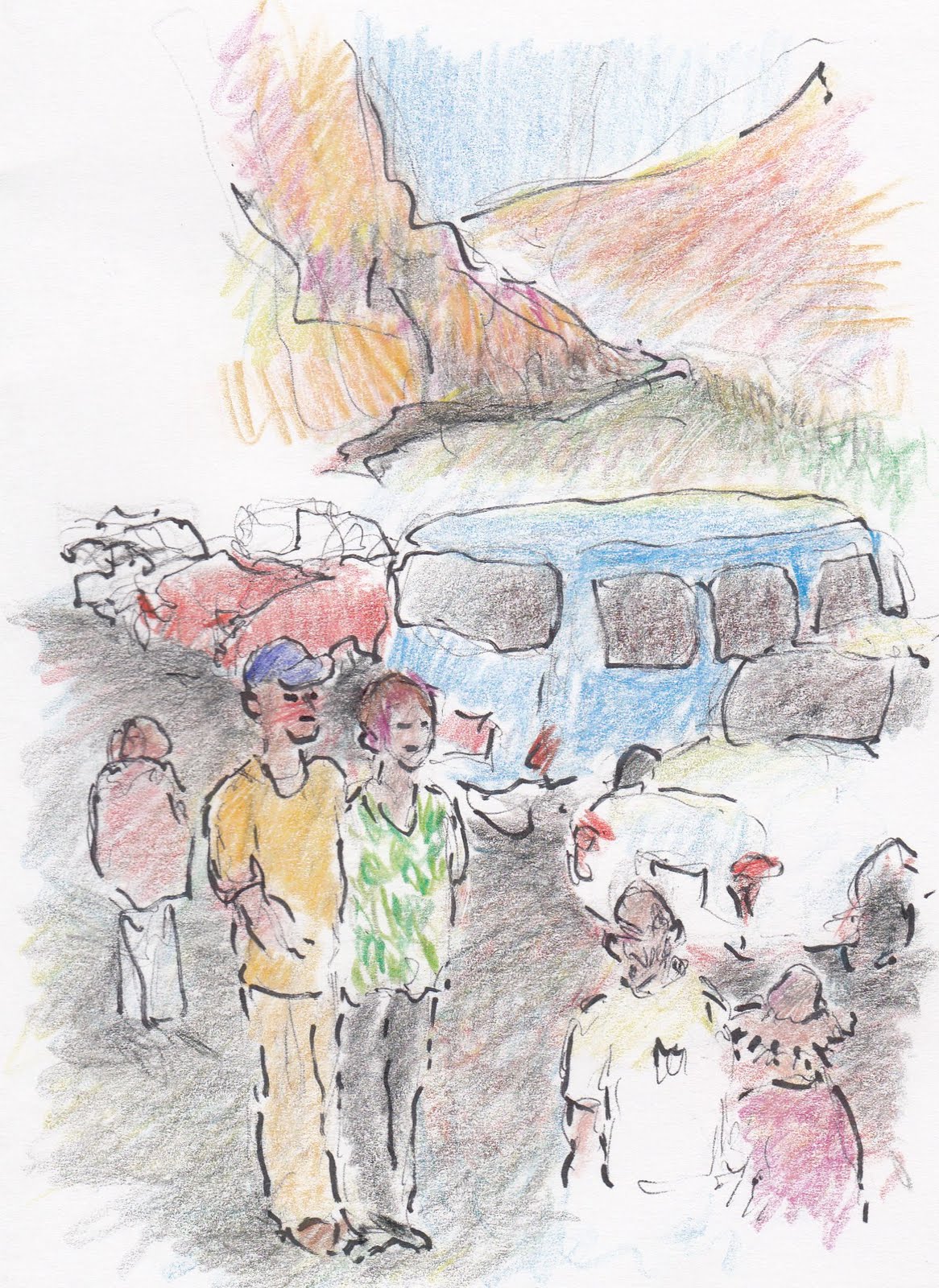
6. Parking Lot


I have mentioned the crowded parking lot at the Montezuma Castle National Monument.


There is a nice paved access road down into the narrow canyon where the ruins are and the parking lot is also paved and well laid out but there were so many visitors that all the spaces were filled and there was a resulting traffic jam--not exactly expected out here in the empty desert!


And the cars were from everywhere! We saw license plates from Arizona  and California, of course--and also from Texas, New Mexico, New York and Florida--even Canada.


We found a parking place though with not such a very long wait and also found a welcome  empty picnic table in the shade of some big cottonwood trees for our lunch--yogurt, bananas, oranges and some good bread. Drinking water was available free at the park.


...