Thursday, December 9, 2010

199. Ain-Gedi Frog


Ain-Gedi Frog

In the morning we hitchhike a ride in a passing pick-up truck to Ain-Gedi, another kibbutz-hostel nearby.


After we install ourselves at the Ain-Gedi Hostel, we hike four miles up a dry gulch between mashed-off stone plateaus, across the remains of ancient irrigation canals into a deep, water-polished gorge when we suddenly hear shouts of laughter. Hidden by overhanging cliffs, a white cascade of pure water bursts from the tan rock and plunges into an emerald green pool. A frolicking gang of Israeli teenagers is just leaving as we arrive.


The pool is perhaps twenty by twenty feet long and wide and twelve feet deep under the fall. We have been left alone, so off go the clothes and into the refreshing, cool water we leap.


A little frog looks at me from a stone at the water’s edge and several fresh-water crabs lurk in the moss. Where did these creatures and the moss come from? Up this canyon from the Dead Sea ages ago before it died?


...

Wednesday, December 8, 2010

198. World War Three


World War III

Later, back at the hostel, we hear gunshots from the direction of the Dead Sea. “That could be the start of World War Three” I quip. “That’s not very funny.” one of the kibbutzim replies and I very clearly see, for the first time, how very unfunny my remark was.


You know, I believe these bred-to-violence humans in this little patch of wasteland would fight each other with sticks and stones if only the weapons-producing nations of the world would stop the endless supply. 

Of course, money buys the weapons, so money is at the root of the problem again, as usual.


Still, doesn’t it seem a shame to draw the whole world into what is basically an ancient feud about some forgotten insult between rival desert tribesmen? 

(The black and white cat wants another fish from the ice-cream freezer.)


...

Saturday, December 4, 2010

197.Kibbutz Life


Kibbutz Life


Back at the hostel, two more busloads of Israeli young people in a very happy and festive mood have arrived. Sunny and I share a room with five of the kibbutzim and we ask them to tell us about their lifestyle.


Two young American kibbutzim say their kibbutzes are very large with 1500 adult workers and about 400 children being cared for in the kibbutz nurseries. Young women are encouraged to have lots of babies, (the girls call the kibbutz “a baby factory”). The natural mothers only care for their babies for a few weeks; as I understand, then go back to work while their offspring are raised in the nurseries where they are indoctrinated into life as an Israeli.


This is the only country I have visited that encourages women to have more babies and early child care is free as a matter of national security.


Each kibbutz has “members”, “guests” (not members but valued workers who are given better living quarters and refrigerators) and “part-time workers” like these Americans, who live in dormitories.


There is no “unemployment problem” in Israel. There is more than enough work for everyone.


But life in a kibbutz seems highly organized and restrictive. It doesn’t appeal at all to me—even for a short time, but Sunny wants to spend the winter in one for the experience.


Sunny and I take a midnight leisurely walk toward the Dead Sea shore but are intercepted by a searchlight-equipped tank filled with Israeli soldiers. The shore of the Dead Sea is off-limits to strollers at night.


A few lights are visible across the lake from Jordan.

Wednesday, December 1, 2010

196. Masada


Masada


Another bus takes us along the shoreline-- stopping to pick up several blond backpackers.


Everybody aboard the bus speaks English.


The bus goes up a dry brown hill to the Masada Youth Hostel where we leave our backpacks.


We want to visit the archaeological site of Masada, an old mesa-top fortress high above the hostel, so we hike to the top of the cliff on “Snake Path” to save the ticket price of the aerial tramway.


It’s an extremely hot hike. We envy the cool tourists as they pass overhead with a science-fiction whir in their elegant cable cars.


We are met at the summit by the usual machine-gun toting security guards, except these are uniformed girls. I have noticed that many of the army personnel here are women and I don’t know whether to salute or flirt. One thing for sure, these soldiers and weapons everywhere mean things are not good in this miserable desert.


The ancient fortress of Masada is now a very eroded heap of adobe ruins. The Romans knew a good military site when they found one though and they newly rebuilt most of the present ruins for their outpost. The mosaic floor of the Roman bathhouse has been nicely restored and there are traces of one of the oldest synagogues in the world and of a Christian church supposedly “built by monks in five A.D.”


An excellent and romantic view from the cliff-top is the interesting geological formation: “The Tongue of the Dead Sea”. 

Black birds sail far below us as the sun sets.


...

Tuesday, November 30, 2010

195. Breakfast and Dead Sea


Breakfast and Dead Sea

Early morning.


Turn left into the first alley inside the Damascus Gate and you will find a little bakery. 

A dried-up baker stands in a pit shoveling dough pancakes into a glowing oven. The pancakes puff up into lovely brown rolls. Little girls in stripped pinafores come and go buying bread for their families’ breakfast for a coin. A patriarch in soiled robes discusses something with a tiny black-haired girl.


Sunny and I buy breakfast in the bakery: three eggs broken into a pastry shell, salted, peppered and baked. While I am eating, a little boy, perhaps four years old, wearing a natty tweed jacket, walks up, puts his chin on my knee and gazes into my eyes with the bright fluid eyes of the very young. I wonder why I so fascinate him.


We catch a bus to the Dead Sea.


Another disappointment.


This celebrated “sea” is a small, narrow lake easily crossed by a weak swimmer. 

We try swimming too but, surprise, the water is so super saturated with salt that we just bounce off. It's like trying to dive into rubber—and the salty brine really stings the eyes!


...

Saturday, November 27, 2010

194. The White Nile


The White Nile


Sunday. 

Church bells. 

It is the Christian’s Sabbath in the Holy City of Peace. 

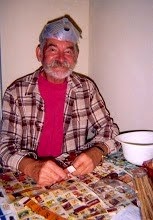
We hike to King David’s Tomb. I pay the twenty-five cent fee, borrow a paper cap and am allowed inside to watch the other American tourists watching me.


Next door to David’s Tomb is “The Upper Room” where the Holy Ghost inspired some of Jesus’ students after His untimely departure. The Ghost is still at it up there; a circle of Christians are moaning and swaying with one finger pointing in the air. They chant: “Save me, sweet Jesus!” in English.


On the ground floor of the same building, some men, apparently Jews, are arguing (also in English) and pounding their fists on a big table.


Around the corner is a church built “on the spot where Mary went to sleep”, as they say, and down a nicely landscaped hillside is the “House of Quality” where contemporary craftsmen display their wares. We go down, of course, and I see a gold-and-crystal ring I covet and a small patient fellow blowing glass goblets.


Sunny loans me a book that I read all night in my room: “The White Nile”; it puts my own little adventure into proper perspective.


...

Friday, November 26, 2010

193. Sightseeing Jerusalem


Sightseeing Jerusalem

In the evening, Sunny fixes dinner for two in her room—cream cheese, raw eggs, apples and bananas sweetened with some sugar. Good, simple home cooking!


Saturday. This is the Jewish Sabbath. Sunny and I walk through Mea Shearim, a subdivision of the New City, where the residents wear Orthodox garb: the men in black robes, white shawls and large fur doughnut hats. No automobiles are allowed in Mea Shearim during the hours of the Sabbath. An old gentleman standing at the barricade that keeps cars out shouts: “Sabbath!” at the passing infidel motorists.


We stroll through other neighborhoods in the New City. This part of Jerusalem looks a lot like a Midwestern American town. We continue through the old city and out into the desert—a long, hot walk to the Garden of Gethsemane.


I am expecting an Agony to strike in the Garden and sure enough, a sparrow is dying in front of the Russian Orthodox Church that is built on the traditional spot where Jesus prayed for the cup to pass without being drained to the last drop


We want to enter the church and a female attendant hands Sunny a shapeless smock to wear, which will cover her exposed knees. (She is wearing practical and not sexy shorts in this horrible heat.) Sunny conforms to the rule though it makes her fume: “Typical male chauvinist sexist tradition!”


...