skip to main |
skip to sidebar
 (Tomasito photo)
20.
Prayer
When I am on pilgrimage, do I “pray” during such mundane lunch breaks?
Prayer is certainly an embarrassingly old-fashioned concept.
Lots of people hate the very sound of the word the notion seems so unfamiliar or so phoney to them—and sometimes in my life it has sounded false to me also though I was raised among “believers”.
Well, I don’t know. For me sometimes “prayer” is words and sometimes it is silence and sometimes it is not so much “praying” as allowing oneself to be “prayed” by whatever “God” is—and there is more than enough mystery there to keep a contemplative soul busy for several lifetimes.
My pilgrimming colleague Peace Pilgrim once said, “Prayer is a concentration of positive thoughts.” and for my kind of pilgrimage of course, the Jesus prayer or some other traditional prayer is the literal environment for every breath.
For some, pilgrimage is a way to atone for past sins, but for me pilgrimage does not cancel out the sins of a lifetime but does provide a certain austerity and occasion to think about their cause and effect.
These wayside field crosses are gentle, periodic reminders for me of who I am, and what I am, have been and will be.
I really don’t know what these field crosses mean to the people who erect and care for them, but they seem purposely designed to inspire a pilgrim like me—and you never see them on the autobahns because high speed driving is not the best time to meditate, though it may be a very good time to pray!
There still may be something to say for being a spiritual athlete after all since “The Way” is said to be narrow, difficult and hard to find––and the crowds probably still miss it, even with the benefits of mass communication and global advertising— since there are, as yet, no package tours to the “kingdom of heaven”––to the chagrin of hoteliers, tour operators and travel writers!
I don’t say that I have found it—that narrow and difficult way. I am just reporting my experience with one traditional way of spiritual development which the old-timers recommend.
I want to report my experience to you but I also know that the way to be a real pilgrim is not to go gather information, return home and tell what happened--since that IS the job of a travel writer.
No, you don’t go on pilgrimage to “show and tell”—you go to go.
Walking, walking, one foot in front of the other, toward the goal… Tomasito, 2009
...
 A Typical Field Cross. (Tomasito photo)
19
Field crosses
The woods are utterly silent. I walk until I am ready to pause and then I enjoy a snack of bread, honey and water sitting on one of the benches which is provided for the tired walker in Germany—even in off the beaten track places like this forest. The bench is placed under a field cross, one of the thousands that are scattered over this extraordinary province. I often pause at these field crosses, sometimes to slip off my pack and stretch a bit, sometimes just to lean on my staff and contemplate.I like these field crosses and don’t view them in a sectarian way at all though they are unquestionably Christian in their history and their symbolic content. To me they seem to be rather beyond dogma—perhaps they are one way a spiritual and humble folk express their faith and their hope in the final goodness of the mystery of life. Field crosses are often large—more than eight feet tall including the shingled roof which shelters the inlaid crucifix from the worst of the weather—and they are often decorated with ornamental plants, freshly gathered flowers, or sometimes, a burning votive candle. They are visited, and visited often, by the rural people who erect and maintain them. The figure of Christ crucified is usually made of painted plaster or sometimes beautifully carved wood and I have never seen one of them desecrated or spoiled by graffiti, though I have heard sadly that some which were sited closer to cities have been vandalized. For some, these field crosses are superstitious nonsense, but I love them.Tomasito, 2009
...
 In the Dunklewald. (Tomasito photo)
18.
Whatever is--is OK.
I believe it is possible to develop a sensitivity or discrimination, which helps distinguish necessary information from superfluous and I have learned to trust my intuition, which I sometimes call my guardian angel, implicitly.
Though it may be only my imagination, it seems to me that some of the people that I meet when I am on pilgrimage, like these two farmers, offer me exactly the aid I need at exactly the right time.
Mist hangs over the rolling hills, blurring the sharply defined periphery of a dark forest above me. The day is still young. The farm road, which I have been directed to follow, curves uphill away from the village church. At the top of the hill there is a view of the sparkling green valley before I plunge into the gloomy woods. New snow sparkles on the black needles of the evergreens. The dirt road underfoot is frozen rock-solid. Tall grasses, silver with ice, fill the clearings.
I am extremely happy to be alive and feel that I am now “in God’s time”, as Mother Theresa of Calcutta put it, where everything is easy.
Even the long uphill hike and my shoulders, sore from the unaccustomed backpack, seem right. I would like to feel like this always.
I have learned while on pilgrimage to be relaxed––to accept whatever occurs as being for my long-term good. My mind is alert, my body is completely engaged, and I am psychologically very tranquil—for one thing, the Jesus prayer is going deep inside me, and for another I have trained myself, through practice, not to waste too much time in worry. What evil can possibly take place when I am in "God’s pocket"? I am entirely content.
I don’t try to control anything or to make anything happen. For this pilgrim at this time—whatever is, is OK.Tomasito, 2009
...
 Bavarian Farmers. (Tomasito photo)
17.
Which way?
Walking, walking—the busy highway leading out of town has a smoothly paved footpath beside it, then the highway narrows and becomes a quiet country lane. As usual in Bavaria, the urgency of traffic ends at the village boundary and the lane and footpath leads leisurely through green hills and pastures. I can choose my own tranquil pace.
The day has become warm. Walking is very pleasant.
I soon approach a crossroads where I must decide which path to take.
A village church is nearby. Like the pilgrims in Herman Hesse’s novel Journey to the East, I try to pause at all places held sacred by the local people to show respect for their spiritual search, so I go into the very old, silent, inspiring house of worship for a tranquil moment’s meditation.
Then I simply stand and wait between the church and the typical farm buildings beside the church.
And here is another technique of pilgrimage, which experience has taught me: If you don’t know what to do next—don’t do anything. Expect the guidance you need to materialize and it will. This procedure may not work for you, but it always works for me, so I advocate it—perhaps if you practice the method it will begin to work for you.
Two men, dressed in the characteristic costume of rustic Bavarian farmers, soon come out of a barn and greet me sociably. When I explain to them, in halting German, that I am an American making a walking pilgrimage to Straubing they are delighted and when I ask them about the best route they are eager to help.
I unfold the highway map my Kolbermoor friends loaned me for the journey and the farmers (after going back into the building for eyeglasses) examine the paper with scientific interest.
Then they carefully fold the map again, explaining that it is just a highway map after all, and begin to outline a more appropriate walking tour for me. They suggest a route across the fields and through the forests and hamlets to the old town of Altotting, which, they assure me, is just as holy a pilgrimage place as Straubing ever was—and which is right on the way to Straubing anyway!
They pool their memories for an itinerary and do not consult any map at all. Their suggested route will take me through the magical-sounding villages of Hemhof, Pelham, Gachensolden and Hoslewang, Obing and Hienberg, Tacherting, Gauching and will terminate in Altotting. They promise I will be on footpaths or country lanes the entire way, then they pose for a snapshot and I continue my journey, which now leads toward Hemhof.Tomasito, 2009
...

16
Pilgrimage Rewards
I walk through the pretty village of Schlossberg.
There is a schloss (castle) here of course, which is quite commonplace in this part of the world since almost every village has its castle and its church, its social hierarchy and its history, and perhaps its bone-deep conservatism and its fear of the stranger—its complacent, satisfied status quo implied by each precise brick and mossy curbstone.
“If there must be change here,” the whole environment seems to say, “let each change be carefully weighed before being implemented.”
So--does my pilgrimage walk represent a challenge to the inhabitants of Schlossberg? Or a danger? Do they see even a little freedom as a dangerous thing?
I think not.
I believe the local folk approve of a foreigner’s sincere feet tracing out the old pilgrim’s paths, and I have never felt anything but welcome here. I respect and honor their old ways—I am here to learn what I can, or teach if I have anything worth teaching—and this is my situation wherever I am.
For this pilgrim, the irksome complexities of organized religion seem to be only trifling cerebral exercises when my body is in motion, I am repeating the pilgrim’s prayer and my heart is open.
Who knows what one believes anyway--when the very meanings of words and creeds are in constant flux—when one understands everything differently today than one did yesterday and when one is sure that as one lives, more will be revealed--and who knows, with all the translations, revisions and changes of the years, what the writers of the ancient creeds really meant?
For me today, this prayer and this walking are the only certainty.
The tradition of pilgrimage, as I have said, is accepted in this land as a spiritual resource and most of the country people do not doubt the value of pilgrimage-- though not all use it as a way.
But the exact rewards of pilgrimage (if any) must remain a mystery.
Tomasito, 2009
...
15
Continuing my way I soon arrive at the Rosenheim River Museum--an outdoor collection of artifacts from the historic past of this part of the Inn River.
There's a fifty-foot flat-bottomed riverboat loaded with antique wooden barrels, some antique machines and several peculiar ballast stones scattered meaningfully about.
The people of Rosenheim take pride in their town’s history and I like it too!
The Inn River, flowing briskly northward at this point, will join the Danube in a hundred or so kilometers. It has been a highway of commerce and culture for centuries and as I wander along it's its banks, I feel myself a particle in the historic flow.
Soon I cross the river on the wide concrete sidewalk of a car-strangled bridge.
The only other pedestrian in sight is a distant young woman pushing a baby carriage.
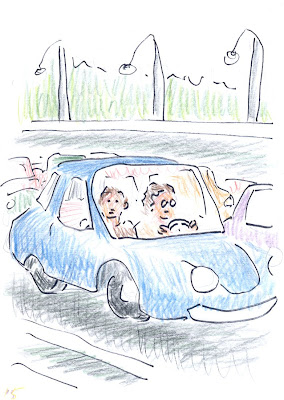
Pausing for the traffic light at the end of the bridge, I examine the blank, hypnotized expressions on the faces of the drivers and passengers in their temporarily stalled vehicles— their daily “rat-race” seems to have canceled their life-energy leaving them quite empty––such a sad contrast from the human face of the young cyclist on the park bench.
Regretfully, just like you, I am also sometimes a particle in this flow—one of the blank millions driving to work—sharing their familiar mostly pointless pilgrimage through life.
Tomasito, 2009
...
 Pilgrim's Equipment, (Tomasito photo)
14
The Bicyclist
I am following the agreeably groomed public walking path beside the river when I see a bicycle rider resting on one of the convenient benches facing the water. I am struck by the appearance of this man.
He is not wearing the almost mandatory German cyclist’s uniform: sport shoes, black spandex shorts, colorful nylon jacket and racing cap. Instead he is dressed in the costume of a Bavarian peasant—and his bike is not the glittering racing machine so common here, but a haphazard collection of what seem to be used bike parts skilfully combined to make a practical riding contraption. He is a young man with a full, brown beard and bright, lively eyes—obviously a free man—one of the very few I have seen lately. The very fact that he is idle-- sitting on this park bench so early on this frosty morning and not peddling along going somewhere frantically speaks well of him to me.
He seems radiant, alive, alert, and keen and he seems to view me—oddly dressed foreigner that I must appear to him to be––with broad good humor.
It takes a lot of courage for a young man in this land of driven perfectionists to sit alone smiling on a park bench so early in the morning.
It’s practically a criminal offence! Why isn’t he off working or on his way to a university or busily doing some important job?
We grin at each other as if we are accomplices in a conspiracy.
As a pilgrim, I too am temporarily free of the normal constraints of routine existence—we smile in recognition of each other’s rare status: at this moment we are both free men. (Kyrie Jesu Christe eleson mas!)
Is it possible to feel this free and this wonderful even when one is living one’s usual humdrum, routine life? Is this feeling of freedom the “holy place” which is the pilgrim’s true goal? Then let me always stand in this holy place!Tomasito, 2009
...